
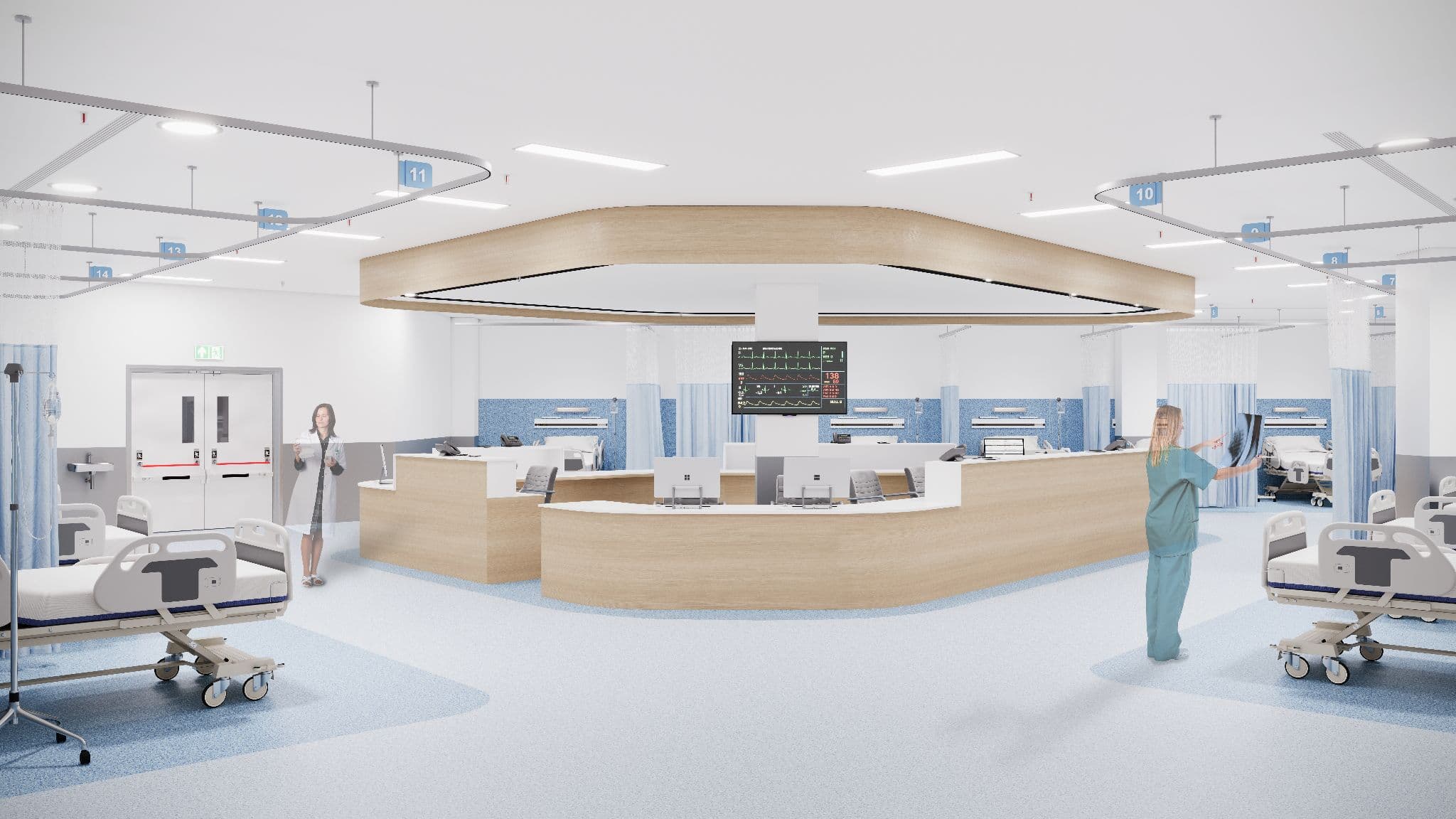
Modular Operation Theatres
A modular OT complex with laminar airflow, CSSD and a medical gas pipeline system.
Surgery asks a great deal of trust. You trust the surgeon, but you also trust the room—its air, its instruments, its lighting, and the systems that keep everything sterile and stable for the hours you are on the table.
Aravinda Hospitals & Advanced Medical Services is a developing 300-bed multispecialty tertiary-care hospital on the NH44 corridor, Telangana, near Mahabubnagar. Its Modular Operation Theatre Complex is being planned as the surgical heart of the hospital, supporting everything from emergency trauma surgery to planned joint replacements and caesarean deliveries.
Here we explain what "modular" means for you as a patient, how the Central Sterile Supply Department (CSSD) and medical gas pipeline system support every operation, and which specialities the complex will serve.
What a modular operation theatre means for patient safety
A modular operation theatre is built from prefabricated, sealed wall and ceiling panels rather than plastered masonry. The joints are flush and the surfaces are non-porous, so there are no corners where dust and microbes can settle, and the room can be cleaned thoroughly between procedures.
Each theatre in the Aravinda Hospitals complex is planned with controlled air handling: filtered air, positive pressure that pushes contaminants out rather than in, and stable temperature and humidity. Surgical lights, pendants for equipment, and integrated control panels are designed into the room rather than added afterwards.
For patients, the practical outcome is a lower risk of surgical-site infection, a calmer and more efficient theatre team, and a room that can be adapted as surgical techniques evolve.
The Central Sterile Supply Department (CSSD)
Behind every operation is the CSSD—the department that receives used instruments, cleans, inspects, packs, sterilises, and stores them, then issues them back to theatre in sealed, tracked sets.
At Aravinda Hospitals the CSSD is being planned as a dedicated department with separate dirty, clean, and sterile zones, so instruments move in one direction only and never cross back. Sterile sets will also supply the Intensive Care Units, the emergency department, labour and delivery suites, and the outpatient clinics.
Linking the CSSD to the hospital information system (HIS) allows each instrument set to be traced to the patient it was used for—a core element of the clinical governance and patient-safety standards the hospital has set for itself.
Medical gas pipeline system and theatre engineering
Anaesthesia depends on a reliable supply of oxygen, medical air, nitrous oxide, and vacuum at every operating table. Rather than cylinders wheeled from room to room, Aravinda Hospitals is being built with a centralised medical gas pipeline system that delivers these gases to theatre pendants, recovery bays, ICUs, and wards.
The system is planned with alarms, back-up supply, and area shut-off valves, giving the anaesthesiology team a stable platform for every procedure.
Recovery bays next to the theatres allow patients to be watched closely as anaesthesia wears off before they return to their room or ward or, where needed, move directly to the ICU.
Surgical specialities the complex will serve
The theatre complex is designed as a shared, multidisciplinary resource. Specialities planned to operate within it include:
- Orthopaedics — fracture fixation, arthroscopy, and joint replacement.
- Neurosurgery — brain and spine procedures.
- General surgery — including laparoscopic (minimally invasive) procedures.
- Obstetrics and gynaecology — caesarean sections and gynaecological surgery.
- Urology, ENT, and surgical oncology.
- Emergency and trauma surgery, 24×7, in coordination with the dedicated trauma care unit.
Endoscopy and day-care procedures will run in their own suite so that short procedures do not compete with major surgery for theatre time.
Planning surgery closer to home
The Modular Operation Theatre Complex is being built so that families in South Telangana and neighbouring regions can have complex surgery near home, with the sterile environment, engineering, and multidisciplinary team it requires. We are happy to keep you informed as the hospital progresses.
Register your interest or call +91 84542 91000. Surgeons and theatre staff interested in joining the team can visit Careers.
Frequently asked questions
What is the difference between a modular and a conventional operation theatre?
A modular theatre uses sealed, prefabricated panels and integrated air handling, creating a seamless, easy-to-clean environment with controlled airflow. Conventional theatres are built with plaster and paint, which are harder to keep sterile.
Will Aravinda Hospitals perform emergency surgery at night?
Yes. The hospital's emergency department and trauma care unit are planned for 24×7 operation, and the theatre complex is designed to support emergency surgery round the clock.
Does the hospital offer robotic surgery?
Robotic surgery is not part of the current plan. The complex is designed for open and minimally invasive (laparoscopic and endoscopic) surgery across the listed specialities.
How are surgical instruments sterilised?
Through the dedicated Central Sterile Supply Department, which cleans, packs, sterilises, and tracks each instrument set before it returns to theatre.
Where do I recover after surgery?
In a recovery bay beside the theatres until you are stable, then in a two-sharing or VIP inpatient room, or in the ICU if your surgeon decides that closer monitoring is needed.