Intensive Care Units
Multi-speciality ICUs with dedicated intensivists, central monitoring and a family waiting lounge.
When someone you love is critically ill, you need two things at once: a team that can act in seconds, and a place where you can wait, ask questions, and be kept informed. The Intensive Care Units at Aravinda Hospitals & Advanced Medical Services are being planned around both.
Aravinda Hospitals is a developing 300-bed multispecialty tertiary-care hospital on the NH44 corridor, Telangana, near Mahabubnagar. Its ICUs are being designed so that families across South Telangana, North Karnataka, and Rayalaseema no longer have to travel to a metro city for critical care.
This page explains how the ICU is being planned, who will care for your family member, how monitoring works, and what you can expect as a relative.
Dedicated intensivists in the ICU, 24×7
Critical care is a speciality in its own right. At Aravinda Hospitals, the ICUs will be led by dedicated intensivists—physicians trained to manage patients whose heart, lungs, kidneys, or brain need close, minute-by-minute support—working alongside critical-care nurses and clinical pharmacists.
The intensivist model means decisions are not delayed until a visiting doctor arrives. A member of the critical-care team will be present in the unit round the clock, and cardiology, neurology and neurosurgery, nephrology, and pulmonology are planned under one roof so consultations happen quickly.
Because the ICUs sit alongside the 24×7 emergency department and the dedicated trauma care unit, a patient who arrives on NH44 in the Golden Hour can move from stabilisation to intensive care without leaving the building.
Central monitoring and critical care technology
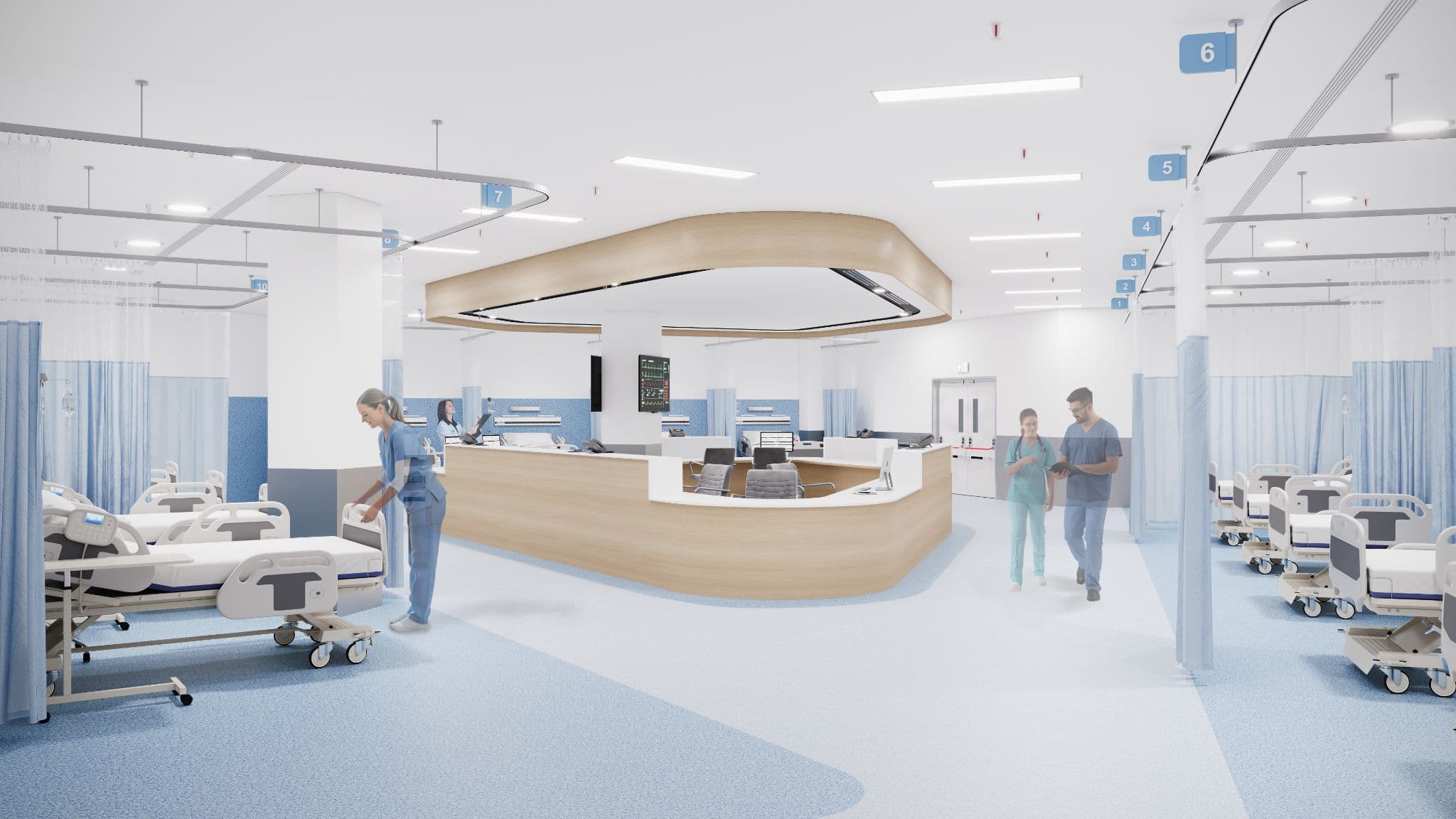
Every ICU bed is planned with continuous bedside monitoring for heart rhythm, blood pressure, oxygen saturation, and respiration. These monitors feed a central monitoring system at the nursing station, so a change in one patient's condition is visible to the whole team, not only to the nurse at that bedside.
The units will be supported by the medical gas pipeline system, ventilatory support, cardiac monitoring systems, and 24×7 access to the laboratory, blood storage and transfusion services, and imaging and diagnostics. In-house dialysis and pharmacy services mean patients who need renal support can receive it in the unit.
Infection control is built into the layout: efficient patient flow, separation of clean and used pathways, and sterile supply from the Central Sterile Supply Department (CSSD).
Critical care units across specialities
Aravinda Hospitals is being planned as a tertiary-care institution, and its critical care capacity is being organised to support the specialities that need it most:
- Medical and surgical intensive care for patients recovering from major surgery or managing serious illness such as sepsis, respiratory failure, or stroke.
- Cardiac monitoring for patients with heart attack, arrhythmia, or heart failure, coordinated with the cardiology department and the planned Cath Lab.
- Neonatal intensive care (NICU) for premature and unwell newborns, working with paediatrics and neonatology and the labour and delivery suites.
- Trauma and emergency critical care for patients brought in from the highway and surrounding mandals.
The precise configuration of each unit will be confirmed closer to opening. The principle will not change: evidence-based protocols, a dedicated team, and patient safety first.
The ICU reception and family waiting lounge
Waiting outside an ICU is one of the hardest things a family does. The architectural renders for Aravinda Hospitals show an ICU reception and waiting lounge designed as a calm, well-lit space with comfortable seating, clear signage, and a staffed reception desk—not a corridor bench.
The reception team will manage visiting slots, relay updates from the clinical team, and help with consent forms and insurance paperwork. Digital medical records through the hospital information system (HIS) mean the doctor speaking to you has the full picture at hand.
We ask families to nominate one or two primary contacts, so that communication stays clear and updates reach the right people at the right time.
Critical care closer to home
The ICUs at Aravinda Hospitals are being built so that the most serious illnesses and injuries in South Telangana can be treated near home, by a dedicated team, with the technology to support them. If you would like updates as the hospital progresses, or you are a clinician interested in critical care roles, we would like to hear from you.
Register your interest or write to care@aravindahospitals.com. In a medical emergency, see what to do in an emergency.
Frequently asked questions
Who looks after patients in the ICU at Aravinda Hospitals?
Dedicated intensivists lead the ICU team, supported by critical-care nurses and the relevant specialist departments. A member of the critical-care team is planned to be present in the unit 24×7.
Can family members visit a patient in the ICU?
Yes, within structured visiting slots that protect patient rest and infection control. The ICU reception team will explain the visiting arrangements and keep nominated relatives updated.
Is there a NICU for newborns?
Yes. A neonatal intensive care unit is part of the hospital's plan, working closely with the labour and delivery suites and the paediatrics and neonatology department.
How does a patient reach the ICU from the emergency department?
The 24×7 emergency department, trauma care unit, imaging, operation theatres, and ICUs are all within the same hospital, so a patient can be stabilised, scanned, operated on, and admitted to intensive care without transfer to another facility.
How many ICU beds will there be?
Unit-level bed numbers will be announced as the hospital nears opening. Aravinda Hospitals is planned as a 300-bed multispecialty hospital with ICUs as a core part of its infrastructure.